Timeline
- Early 2000s: With PCs getting cheaper and cheaper, and Apple narrowing their line to four models—the PowerBook and iBook laptops, the all-in-one iMac, and the powerful-but-huge-and-rather-pricey PowerMac, Mac fans start clamoring for a small, capable Mac without a built-in screen.
- Late December 2004:
Rumors start flying
about an inexpensive "headless" Mac.
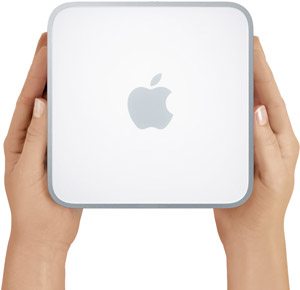
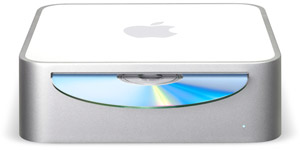
- January 11, 2005: At MacWorld San Francisco, Steve Jobs introduces the Mac mini. (Capital-M-Mac, lowercase-m-mini.) $499 gets you a 6.5"x6.5"x2" box (successor to the failed G4 cube and the NeXTcube) with a 1.25 GHz G4 CPU, 256 MB RAM, a 32 MB video card, a 40 GB hard drive, a combo drive (DVD-ROM/CD-RW), Mac OS X 10.3 ("Panther"), and iLife 05 (also introduced that day.) Back then, a single 1.25 GHz CPU was pretty respectable. To compare, the PowerMac G4 was gone and the G5 was available with multiple 2.5 GHz CPUs but the PowerBook G4 of the day was only 1.5 GHz (bumped to 1.67 GHz on 1/31/05) and the iMac had only a single 1.6 ($1,299) or 1.8 ($1,499) GHz G5 CPU. A $599 model has a 1.42 GHz CPU and an 80 GB hard drive. A SuperDrive (DVD burner) is optional, Bluetooth and AirPort wireless are separate options, and RAM is expandable to 512 MB ($50) or 1 GB ($425!!!) Sales of putty knives skyrocket. They are scheduled to ship Saturday, January 22. Other small news of the day: the iPod shuffle is introduced.
- January 22, 2005: They ship. I buy one. I had already ordered one but I didn't get my order in right away so mine won't ship for a few weeks, but since I was planning to get a couple anyway I go ahead and get a base model in the store. I love it right away. My second (first? I don't know) Mini—1.25 GHz, 512 MB, 80 GB—arrives on February 3. This mini is quickly pushed into service hosting a few small websites out of my house (replacing an old PC with Linux) and it continues to do so to this day—five years of 24/7/365 operation (other than software updates and power outages.) Also in January 2005, Macminicolo.net starts hosting ("colocating") Mac minis as web servers.
$ whois macminicolo.net
Domain Name: MACMINICOLO.NET
Created on: 13-Jan-05
(Historical note: A NeXTcube was the world's first web server.)
- Early 2005: Other than the pricey RAM, everyone is happy. (Except for those who never are.) The Mini seems nicely poised to be a home theater PC. Its DVI output can be used to drive an HDMI TV (though wacky EDTV/HTDV resolutions, like 854x480 or 1366x768, are not natively supported) and an adapter with composite and S-Video connectors for regular TVs is also available. (Note that this no longer works with Minis made after March 2009.) The CenterStage Project--a home media center app for Macs, specifically the Mini--is started. Later, several other home-theater-type apps come out, including Apple's Front Row. CenterStage takes forever to get nowhere and eventaully dies.
- April 2005: Mac OS X 10.4 ("Tiger") is released.
- Summer 2005: At Apple's Worldwide Developer's Confernce, the company's transition to Intel CPUs is announced.
- Late 2005: Minis are silently upgraded to 1.33/1.5 GHz CPUs and 64 MB graphics.
- February 2006: The Mini transitions to Intel (following the PowerBook/MacBook Pro and iMac in January) with 1.5 GHz Intel Core Solo and 1.66 Core Duo CPUs. The price jumps up $100 to $599 and $699 for the two standard configs. Hard drives change from IDE (PATA) to SATA. The modem is history (a USB modem is available) but there are now 4 USB ports. It also gains a built-in infrared remote receiver (and Front Row), optical digital audio output, and the video chipset is changed to the Intel GMA950 GPU, which shares system memory and has stellar HD video capabilities but worse 3D performance than the earlier model's discreet graphics. Gamers care, the rest of the world doesn't. With the remote control, Front Row, digital audio, and excellent video playback capabilities, the Mini because a very powerful home theater PC indeed.
- September 2006: The Core Solo Mini is axed. Standard configs are the $599, 1.66 GHz Core Duo and the $799 (gulp!) 1.83 GHz model.
- Early/mid 2007: iPhone is announced and released.
- August 2007: After 11 months of no Mini updates and a little worrying about the possibility of the line being killed, the Mac mini is upgraded to Core 2 Duo CPUs. (Update, 1/12/12: this is the first Mini that will run 10.7.)
- October 2007: Mac OS X 10.5 ("Leopard") is released.
- March 2009: After 19 months of no Mini updates and a lot of worrying about the line, the Mini is revised again, now with two (!!!) display connectors (mini DVI and mini DisplayPort; capable of running two monitors at once) and a fifth USB port. Apple fans, also worried about the possible death of FireWire, are happy to see it still included (now as FireWire 800) on the Mini.
- August 2009: Mac OS X 10.6 ("Snow Leopard") is released.
- October 2009: Another small performance boost. Sadly, no additional USB ports are included in this revision. However, a $999 server model is introduced, with two 500 GB hard drives, no optical drive, and Mac OS X 10.6 Server. Mac geeks the world over pass out.
- January 2010: The Mac mini celebrates its fifth birthday. Satisfied that their beloved Mini is safe, Mac fans start anticipating a tablet.
brianashe@gmail.com